


Non-Geostationary Satellite Orbit (NGSO)
ETL Systems supports a wide range of satellite communications ground infrastructure, including the rapidly expanding Non-Geostationary Satellite Orbit (NGSO) segment.
NGSO encompasses Low Earth Orbit (LEO), Medium Earth Orbit (MEO), and Highly Elliptical Orbit (HEO) missions. Growth in this sector has accelerated with the rise of LEO operators such as SpaceX Starlink, OneWeb, Planet Labs, Airbus SE and others, who are delivering low-latency, high-speed connectivity to some of the most remote and underserved regions on the planet.
Each NGSO architecture relies on ground-based teleports to link the constellation with terrestrial networks. These facilities form the gateway between space and Earth, routing vast volumes of data to and from end users. Designed to handle dynamic tracking, rapid handovers and wide operating bandwidths, NGSO teleports must support a broad range of RF frequencies – including the Ku- and Ka-band channels commonly used for high-data-rate LEO services.
ETL Systems provides a comprehensive portfolio of RF technologies to meet these demands, including high-performance switch matrices, agile and fixed frequency converters (BUCs, LNBs and converter variants), solid-state and TWT amplifiers, and RF over Fibre solutions. These products are engineered to maintain signal integrity, support redundancy architectures and deliver reliable operation within fast-moving, high-throughput NGSO environments.

Featured products
Deployed in deep space gateways around the world
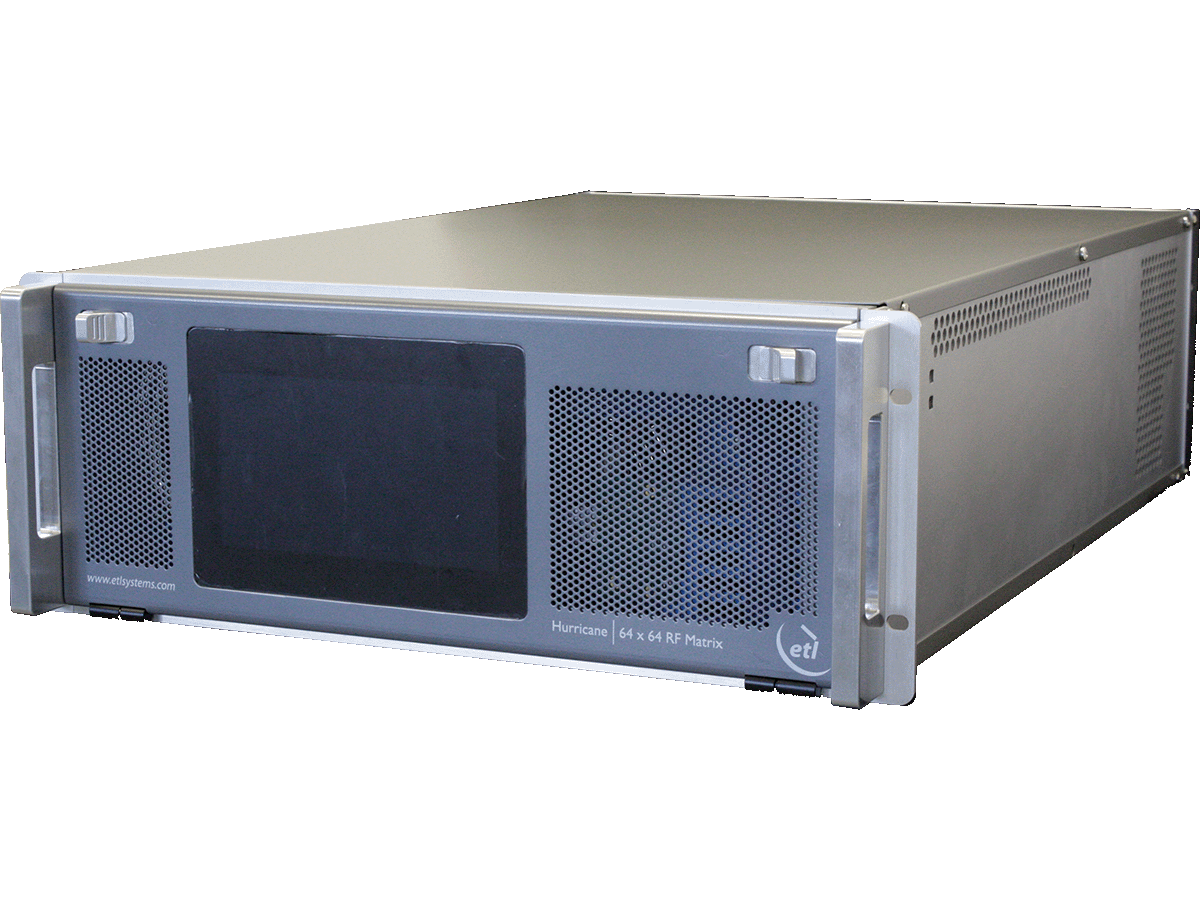
HUR-10
HURRICANE 64x64 distributive matrix
850-2450MHz extended L-band range, ultra-configurable model

HWK-G1S-15-F44
HAWK 4x4 FIFO matrix module
500-3150MHz extended L-band range, with unity gain
HWK-G1S-15-D44
HAWK 4x4 distributive matrix module
500-3150MHz extended L-band range, with unity gain

VTRC-102-XXXX-1616
VICTOR 16x16 combining matrix
850-2450MHz extended L-band range, with variable gain/RF detection
VTRC-100-XXXX-2408
VICTOR 24x8 combining matrix
850-2450MHz extended L-band range, with variable gain
NGSO networks
- Significant volume of gateway antenna sites required to support the frequent satellite handover (every 15-20 minutes in the case of LEO satellites).
- Complexity of architecture and ground system technology required for tracking multiple satellites.
- Smaller antennas and gateways typically require more compact sub-systems.
- High frequency bands in the RF spectrum are becoming increasingly congested; satellite operators seek to utilise different frequency bands in different jurisdictions around the world.
- Significant volume of gateway antenna sites required to support the frequent satellite handover (every 15-20 minutes in the case of LEO satellites).
- Complexity of architecture and ground system technology required for tracking multiple satellites.
- Smaller antennas and gateways typically require more compact sub-systems.
- High frequency bands in the RF spectrum are becoming increasingly congested; satellite operators seek to utilise different frequency bands in different jurisdictions around the world.
- Significant volume of gateway antenna sites required to support the frequent satellite handover (every 15-20 minutes in the case of LEO satellites).
- Complexity of architecture and ground system technology required for tracking multiple satellites.
- Smaller antennas and gateways typically require more compact sub-systems.
- High frequency bands in the RF spectrum are becoming increasingly congested; satellite operators seek to utilise different frequency bands in different jurisdictions around the world.


Low Earth Orbit (LEO) Satellites are in orbit at altitudes between 160 to 2,000 kilometres. For complete Earth coverage and due to their limited (momentary) Field of View (FoV), a high number of satellites are required. Unlike GEO satellites, which are stationary relative to the Earth’s rotation, LEO satellites at 1000Km altitude have an orbital velocity relative to the Earth of about 7.3km/s.
On the ground, this means 2 to 3 antennas must be provided for tracking and satellite changeover. However, due to the reduced gain requirement these antennas are smaller than GEO satellite antennas – typically having a maximum diameter of 2.4m and using both Ka- and Ku-bands.
With low cost, ease of maintainability, small form factor and extended bandwidth all expected requirements for LEO ground segment equipment, ETL has a range of products designed to fit these needs, depending on the antenna hub requirements. ETL’s latest introduction, the Genus chassis, is a compact common chassis with a range of functions, broad frequency ranges and a scalable design to fit into small and large teleports.
LEO applications broadly fit into two categories:
Broadband internet access direct to end users/consumers
For latency critical applications e.g. Financial transactions, autonomous cars, remote video surgery etc LEO’s will be the first choice as the round-trip latency of a LEO satellite is roughly 10 times lower than a GEO satellite.
Enterprise and Government
As some planes in some LEO constellations are being laser linked this gives the possibly of a highly secure link independent of the internet. Ideal for private enterprise and government communications.
Lorem ipsum dolor sit amet, consectetur adipiscing elit. Etiam viverra magna sodales, pretium purus lacinia, iaculis elit. Curabitur at hendrerit mauris. Mauris cursus odio est, et faucibus felis vestibulum vitae. Donec pretium at nibh eget auctor. Morbi tristique eros tellus, sit amet suscipit erat mollis a.
Interdum et malesuada fames ac ante ipsum primis in faucibus. Nam commodo eget lectus vitae egestas. Maecenas nec placerat orci. Phasellus lobortis, ante non faucibus rhoncus, dolor metus aliquet diam, vitae laoreet orci purus vitae nisi. Donec sollicitudin erat id metus rhoncus scelerisque. Nulla mattis eros ut iaculis consectetur. In turpis dolor, gravida eget lorem pretium, ullamcorper dapibus ex. In efficitur, mi quis maximus maximus, leo augue rutrum nulla, quis ultrices sapien arcu nec nisi. Nam a ante urna.
Integer consectetur, risus vel blandit pulvinar, nulla libero semper ex, quis maximus elit purus tristique velit. Nulla ac porta mi. Suspendisse potenti. Sed ornare elit auctor sapien feugiat ultrices.
Morbi porta lorem enim, sit amet scelerisque urna accumsan sit amet. Vestibulum ante ipsum primis in faucibus orci luctus et ultrices posuere cubilia curae; In hac habitasse platea dictumst. Integer eleifend cursus justo sollicitudin convallis. Pellentesque congue eget sapien sit amet suscipit.
Cras molestie elit nibh, vel viverra leo finibus id. Duis commodo, lectus ut egestas bibendum, elit arcu vestibulum orci, at accumsan ipsum nunc sed justo. Donec quis interdum nunc. Suspendisse potenti. Maecenas sollicitudin non enim sed aliquam. Fusce et vulputate mauris, vitae luctus enim. Etiam fermentum lectus nec pharetra lacinia. Aliquam laoreet egestas euismod. Cras consectetur, tortor at consequat ultrices, libero risus convallis eros, nec tincidunt ante eros in leo. Sed congue rhoncus molestie.
Suspendisse enim mi, consectetur non magna quis, pharetra hendrerit sem. Nunc sed nulla vel eros varius pulvinar. Nam ipsum lectus, commodo et orci eget, pretium elementum augue. Integer id nunc tempor ex vulputate pharetra eget eu leo. Integer ac congue ante. Nulla a augue non mauris eleifend posuere. Nam fringilla eu enim a pulvinar. Phasellus ac sagittis dolor. Suspendisse potenti. Integer dignissim ex non tellus dignissim congue.

Engineered for Reliable RF Performance
Every RF environment is unique. Our expert engineers design and manufacture systems tailored to your specifications — ensuring unmatched scalability, reliability, and performance.